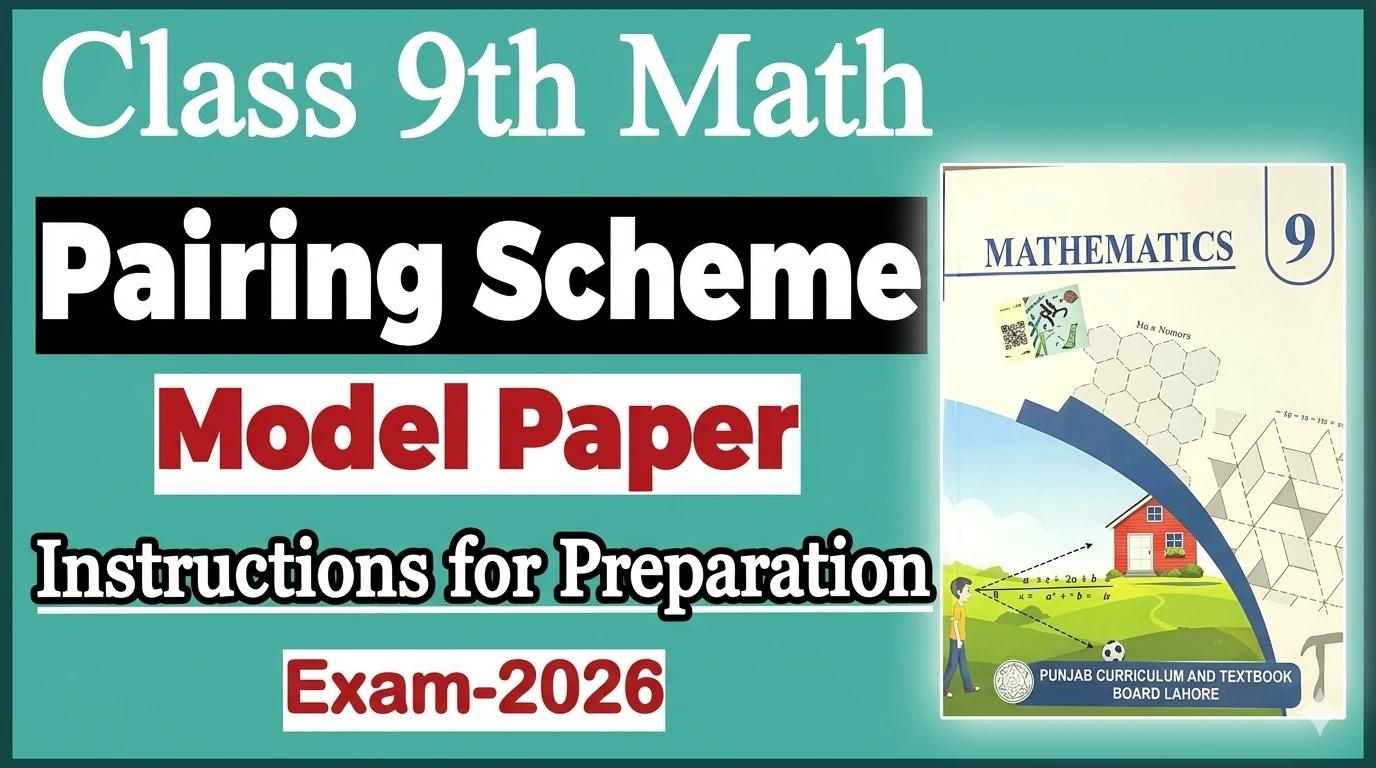
The 9th class mathematics examination for 2026 follows a new reduced curriculum with a restructured paper pattern. The total marks allocated for the mathematics paper is 75, divided into objective and subjective portions. Understanding the pairing scheme is essential for students to know which chapters will contribute questions to their examination and how many marks each section carries. This guide provides a comprehensive breakdown of how the examination will be structured based on the official pairing scheme.
Objective Type Questions (Multiple Choice Questions)
The objective portion of the mathematics paper consists of 15 multiple choice questions worth 15 marks total. The distribution of MCQs across chapters follows a specific pattern that students should memorize. Nine chapters will contribute one MCQ each, while three selected chapters will contribute two MCQs each. The chapters contributing single MCQs are chapters 1, 2, 5, 7, 9, 10, 11, 12, and 13. Chapters 3, 4, and 6 will each provide two MCQs, completing the total of 15 questions. This structure ensures that chapters with additional importance have more representation in the objective section.
| Chapter | Single MCQ | Double MCQ | Total MCQs |
|---|---|---|---|
| 1 | 1 | – | 1 |
| 2 | 1 | – | 1 |
| 3 | – | 2 | 2 |
| 4 | – | 2 | 2 |
| 5 | 1 | – | 1 |
| 6 | – | 2 | 2 |
| 7 | 1 | – | 1 |
| 9 | 1 | – | 1 |
| 10 | 1 | – | 1 |
| 11 | 1 | – | 1 |
| 12 | 1 | – | 1 |
| 13 | 1 | – | 1 |
| Total | 9 | 6 | 15 |
Short Questions – First Section
The short questions portion is divided into three sections, with the first section containing nine questions from which students must attempt any six. Each short question carries 2 marks, making this section worth 12 marks in total. The short questions in the first section are selected from chapters 1, 2, 3, and 4, with two questions selected from each of these chapters. Additionally, one short question will be included from chapter 5. This distribution ensures comprehensive coverage of the fundamental chapters in the curriculum.
| Chapter | Number of Short Questions | Marks per Question | Total Marks |
|---|---|---|---|
| 1 | 2 | 2 | 4 |
| 2 | 2 | 2 | 4 |
| 3 | 2 | 2 | 4 |
| 4 | 2 | 2 | 4 |
| 5 | 1 | 2 | 2 |
| Total Questions (Attempt 6) | 9 | 2 | 12 |
Short Questions – Second Section
The second section of short questions also presents nine questions with students required to attempt any six. Each question again carries 2 marks for a total of 12 marks. The chapters from which these questions are drawn include chapters 6, 7, 8, and 9. Three short questions will be selected from each of these four chapters, covering all important concepts in this section of the reduced syllabus. Students should prepare all topics from these chapters to be ready for any combination of questions.
| Chapter | Number of Short Questions | Marks per Question | Total Marks |
|---|---|---|---|
| 6 | 3 | 2 | 6 |
| 7 | 3 | 2 | 6 |
| 8 | 3 | 2 | 6 |
| 9 | 3 | 2 | 6 |
| Total Questions (Attempt 6) | 9 | 2 | 12 |
Short Questions – Third Section
The third section continues the same format with nine short questions and a requirement to attempt six. This section draws from chapters 10, 11, 12, and 13. Two short questions are selected from each of chapters 10, 11, and 13, while three short questions come from chapter 12. This distribution totals nine questions, and students must select any six to answer. The variation in chapter contributions reflects the importance of different topics in the curriculum.
| Chapter | Number of Short Questions | Marks per Question | Total Marks |
|---|---|---|---|
| 10 | 2 | 2 | 4 |
| 11 | 2 | 2 | 4 |
| 12 | 3 | 2 | 6 |
| 13 | 2 | 2 | 4 |
| Total Questions (Attempt 6) | 9 | 2 | 12 |
Long Questions – First Section
The first section of long questions contains three questions, each worth 8 marks, from which students must attempt any two. These questions have both part A and part B, meaning students must complete both parts to fully answer one question. The total marks available in this section is 16 marks, though students only need to secure marks from two complete questions. The chapters from which these questions originate are chapters 1, 2, 3, and 4. The first question comes from chapter 1, the second from chapter 2, the third from chapter 3, and the fourth from chapter 4.
| Question | Chapter Source | Parts | Marks per Question | Total Marks |
|---|---|---|---|---|
| Q5 | 1 & 2 | A & B | 8 | 8 |
| Q6 | 3 & 4 | A & B | 8 | 8 |
| Q7 | – | A & B | 8 | 8 |
| Total (Attempt 2) | 1-4 | A & B | 8 | 16 |
Long Questions – Second Section
The second section of long questions contains only two questions, each worth 8 marks, from which students must attempt exactly one. This section differs from others in that students have limited choice. One long question will be selected from either chapter 7 or chapter 10, while another will definitely come from chapter 9. The final question in this section will be selected from either chapter 11 or chapter 13, with chapter 12 also contributing one question. This section tests understanding of more complex topics from the later chapters of the curriculum.
| Question | Chapter Source | Parts | Marks per Question | Total Marks |
|---|---|---|---|---|
| Q8 | 7 or 10 + 9 | A & B | 8 | 8 |
| Q9 | 12 + (11 or 13) | A & B | 8 | 8 |
| Total (Attempt 1) | 7-13 | A & B | 8 | 8 |
Complete Paper Structure Overview
| Section | Type | Number of Questions | Questions to Attempt | Marks per Question | Total Marks |
|---|---|---|---|---|---|
| I | MCQs | 15 | 15 | 1 | 15 |
| II | Short (Section 1) | 9 | 6 | 2 | 12 |
| III | Short (Section 2) | 9 | 6 | 2 | 12 |
| IV | Short (Section 3) | 9 | 6 | 2 | 12 |
| V | Long (Section 1) | 3 | 2 | 8 | 16 |
| VI | Long (Section 2) | 2 | 1 | 8 | 8 |
| TOTAL PAPER | Mixed | 47 | 36 | Various | 75 |
Total Marks Distribution
When all sections are combined, the total marks structure becomes clear. The 15 MCQs contribute 15 marks, the three short question sections contribute 12 marks each for a total of 36 marks, and the two long question sections contribute 16 and 8 marks respectively for a total of 24 marks. When these are added together (15 + 36 + 24), the complete paper totals 75 marks. Students should allocate their preparation time proportionally across all sections to ensure balanced readiness. For more information about examination guidelines and result checking, visit BISE 9th Result.
| Component | Marks | Percentage of Total |
|---|---|---|
| Objective (MCQs) | 15 | 20% |
| Short Questions | 36 | 48% |
| Long Questions | 24 | 32% |
| Total | 75 | 100% |
Model Paper Format Explanation
The official model paper released by the board demonstrates how the pairing scheme translates into an actual examination. The model paper follows the exact structure outlined in the pairing scheme, with 15 MCQs in the first section followed by three sections of nine short questions each. The long questions section shows how questions are subdivided into parts A and B, with students needing to complete entire questions rather than individual parts. Studying the model paper helps students understand the expected format and difficulty level of actual examination questions.
| Paper Section | Questions Provided | Questions to Solve | Time Allocation |
|---|---|---|---|
| MCQs | 15 | 15 | 20 minutes |
| Short Questions – Part 1 | 9 | 6 | 45 minutes |
| Short Questions – Part 2 | 9 | 6 | 45 minutes |
| Short Questions – Part 3 | 9 | 6 | 45 minutes |
| Long Questions – Part 1 | 3 | 2 | 50 minutes |
| Long Questions – Part 2 | 2 | 1 | 25 minutes |
| Total | 47 | 36 | 230 minutes |
Preparation Strategy Based on Pairing Scheme
Understanding the pairing scheme allows students to create an effective study plan. Since certain chapters have more representation in the examination, students should allocate additional preparation time to chapters 3, 4, and 6, which contribute extra MCQs. Similarly, chapters 1 through 4 have significant representation in the short and long question sections, making them critical for examination success. Students should solve practice questions from all chapters according to the pairing scheme distribution to build confidence and familiarity with question patterns.
| Chapter | MCQ Contribution | Short Questions | Long Questions | Priority Level |
|---|---|---|---|---|
| 1 | 1 | 2 | Yes | High |
| 2 | 1 | 2 | Yes | High |
| 3 | 2 | 2 | Yes | Very High |
| 4 | 2 | 2 | Yes | Very High |
| 5 | 1 | 1 | No | Medium |
| 6 | 2 | 3 | No | Very High |
| 7 | 1 | 3 | Possible | High |
| 8 | – | 3 | No | Medium |
| 9 | 1 | 3 | Yes | High |
| 10 | 1 | 2 | Possible | High |
| 11 | 1 | 2 | Possible | Medium |
| 12 | 1 | 3 | Yes | High |
| 13 | 1 | 2 | Possible | Medium |
Important Considerations for 2026 Examination
The 2026 mathematics curriculum differs significantly from previous years, notably in the exclusion of theorems that were present in older textbooks. This elimination affects the long question pattern, which no longer requires theorem-based answers. Students should focus on practical problem-solving and applications rather than theoretical proofs. The new pattern emphasizes conceptual understanding and application of mathematical principles across real-world scenarios. Staying updated with official announcements from educational boards ensures students follow the correct curriculum and examination patterns.
For additional resources and information about the 9th class examination, students can visit the official BISE website or contact their respective boards. Information about result checking procedures is available on platforms dedicated to 9th class results, and students can also find contact information for direct board assistance.